







Free initial advice
Manual Handling Claim FAQs
If you've been hurt, our trusted solicitors can help
No upfront fees. No obligation. A specialist will review your enquiry and come back to you.
Trusted by injured people across the UK




Free initial advice
If you've been hurt, our trusted solicitors can help
No upfront fees. No obligation. A specialist will review your enquiry and come back to you.
Trusted by injured people across the UK
This guide will discuss frequently asked questions regarding manual handling claims.
A manual handling injury can occur from lifting or moving heavy objects at work. However, in order to begin a personal injury claim following a manual handling accident at work, you need to show you meet the eligibility criteria. As such, to begin, we discuss when a compensation claim could be made against an employer for a manual handling accident.
We also cover other important aspects related to work-related claims, such as the time limit for starting a personal injury claim and how compensation can address financial losses as well as pain and suffering caused by the injuries you suffered in an accident.
As the guide progresses, you will get a clear overview of who is responsible for preventing manual handling incidents in the workplace and the legislation that needs to be adhered to.
Finally, we discuss how a No Win No Fee solicitor can assist you in seeking compensation for your manual handling injuries.
For more information, please contact an advisor using the details provided below. They can answer any questions you might have regarding your potential claim for free.

Manual handling refers to any activity where you lift, lower, carry, push, pull or otherwise move a load. A load is a movable object, such as a box or package but can also include a roll cage or pallet truck.
Your employer may ask you to perform manual handling tasks as part of your job. They have to ensure you are as safe as possible when doing these tasks. A manual handling compensation claim could potentially arise if they failed to do so leading you to become injured.
Call the number above if you have any questions about how to claim compensation for a manual handling accident.
Section 2 of the Health and Safety at Work etc. Act 1974 (HASAWA) outlines an employer’s duty of care. They must take all reasonable and practicable steps to keep employees safe from harm at work and as they carry out their work-related duties. An employer could be responsible for an employee’s injury if they fail in this duty.
Furthermore, manual handling claims could be valid if the following eligibility criteria are met:
These three points set the definition of negligence in tort law. You need to have evidence of this in order to seek personal injury compensation.
Call us to discuss your specific case and find out whether you could make a manual handling claim for employer negligence. An advisor can offer guidance for free.
The time limit set out by The Limitation Act 1980 means you have three years from the accident date to start a personal injury claim.
There are some exceptions to the time limit in some circumstances. For example, if a claimant lacks the mental capacity to take legal action after an accident, the time limit is paused indefinitely. A litigation friend could be appointed by the courts to make a claim on their behalf during this time. Alternatively, if they recover their capacity and no claim has been made for them, the three-year limit would begin from their recovery date.
Exceptions can also be made to the time limit if the person claiming is under the age of 18.
Call and speak to an advisor if you want to learn how long you have to start an accident at work claim. They can also share more information on manual handling injury claims, including whether one of our helpful and experienced solicitors could assist you in seeking compensation.
The payout awarded following a manual handling compensation claim will depend on the specific circumstances of your case. Generally, though, you could be awarded a settlement comprising up to two heads of claim. These are general damages and special damages.
General damages is the primary head of claim compensating for the pain and suffering caused by your manual handling injuries.
Those responsible for calculating the value of your compensation claim can use medical evidence alongside the Judicial College Guidelines (JCG) to help them. This document includes guideline compensation brackets for different injuries, some of which you could experience because of a manual handling accident such as a back injury, a fractured ankle, and arm injury.
The table below features guideline compensation figures that can be found in the JCG. However, please note that the top entry is not from the JCG. This table should only be used as a guide because manual handling compensation payouts vary from case to case.
| INJURY | SEVERITY | COMPENSATION GUIDELINES | NOTES |
|---|---|---|---|
| Multiple Serious Injuries Plus Special Damages | Serious | Up to £250,000+ | Compensation reflecting the pain and suffering of multiple serious injuries, physical and/or psychological, as well as financial losses such as a loss of earnings, care costs, and travel costs. |
| Neck | Severe (ii) | £65,740 to £130,930 | Damage to discs in the cervical spine causing disabilities that are considerably severe. |
| Severe (iii) | £45,470 to £55,990 | Severe soft tissue damage and/or ruptured tendons causing chronic conditions and a significant and permanent disability. | |
| Moderate (i) | £24,990 to £38,490 | Serious soft tissue injuries to the neck and back. | |
| Back | Severe (ii) | £74,160 to £88,430 | Nerve root damage with other issues, such as lost sensation. |
| Severe (iii) | £38,780 to £69,730 | Disc lesions or disc fractures as well as soft tissue injuries causing chronic conditions are covered in this bracket. | |
| Moderate (i) | £27,760 to £38,780 | Cases of damage to an intervertebral disc with some irritation to the nerve roots and reduced mobility. | |
| Arm | Less Severe | £19,200 to £39,170 | A substantial degree of recovery despite significant disabilities. |
| Elbow | Moderate or Minor | Up to £12,590 | Injuries that don’t cause any permanent function impairment or permanent damage. |
A secondary head of claim, called special damages, may also be included in a settlement. For example, if an injury suffered while lifting or carrying leads to financial losses, special damages can be awarded to compensate for these. For example, you could claim back:
Keep track of your expenses by collecting documents including payslips, invoices, and bank statements.
Call our team on the number above to find out more about how compensation for manual handling claims is calculated and what you could potentially receive if you succeed with your case.

The Health and Safety Executive (HSE), Britain’s workplace health and safety regulator, provides helpful workplace accident statistics.
In 2022/23, these statistics show that employers reported 60,645 non-fatal injuries to employees under the Reporting of Injuries, Diseases and Dangerous Occurrences Regulations (RIDDOR). 17% of those injuries were related to handling, lifting or carrying.
However, not all of the manual handling injuries sustained at work during this period will have been caused by employer negligence.
If you were involved in a manual handling accident that caused injuries due to a breach of your employer’s duty of care, call today to find out what your options are.
Whilst HASAWA is the central piece of health and safety legislation that outlines the general duty of care employers owe their employees, there are other pieces of legislation that set out the more specific responsibilities they have depending on the type of workplace they operate.
For example, The Manual Handling Operations Regulations 1992 sets out that employers should avoid the need for employees to carry out any manual handling activities that involve a risk of injury, if it is reasonably practicable for them to do so.
It further states that if manual handling operations that pose a risk of injury cannot be avoided, steps should be taken to reduce the risk involved. They should also carry out a risk assessment before any tasks are performed.
Examples of the ways they could reduce the risk of injury include:
If their is a failure to adhere to the relevant legislation, and this causes a manual handling injury at work, you could have a valid accident at work compensation claim. Call the number above to find out more.
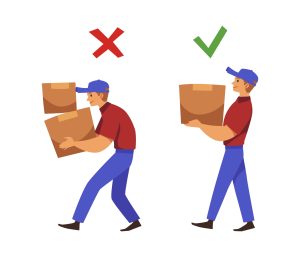
Employers should assess the risk of any unavoidable manual handling task where injury is possible. Among the factors they should consider are the task, the load, the working environment and the capability of the individual. More specifically consideration should be given to:
Have you been in an accident at work due to employer negligence where you suffered manual handling injuries as a result? Get in touch today to learn if one of our specialist manual handling solicitors could help you.
If you’re eligible to instruct them to represent your case, they could offer their services under No Win No Fee terms by offering you a Conditional Fee Agreement (CFA).
Under a CFA, you typically won’t need to pay upfront or ongoing costs for the solicitor’s work. You also won’t need to pay for their services if the claim fails.
If the claim succeeds, you’ll pay a success fee from your compensation. This is usually deducted as a percentage with a legal limit. As such, you can ensure you receive the majority of your awarded settlement.
For more information on how an expert personal injury solicitor could help with manual handling claims, please contact an advisor. To do so, you can:

Here are some further accident at work claim guides:
These resources could also help:
Thank you for reading our guide on frequently asked questions about manual handling claims. Please call or contact us online if you have any other questions.