







Free initial advice
A Guide About Warehouse Accident Claims
If you've been hurt, our trusted solicitors can help
No upfront fees. No obligation. A specialist will review your enquiry and come back to you.
Trusted by injured people across the UK




Free initial advice
If you've been hurt, our trusted solicitors can help
No upfront fees. No obligation. A specialist will review your enquiry and come back to you.
Trusted by injured people across the UK
If you are the victim of an accident at work and are thinking about starting a warehouse accident claim for compensation, this guide can help. Whether you fell or slipped or were asked to move something too heavy for you, we start this guide by explaining how you could be eligible to seek damages.
Personal injury claims need to show a duty of care was breached by your employer and that this caused your injuries, so we explain that in detail. We look at how warehouse accidents can happen and the importance of reporting one. After this, we explore compensation itself and look at how it is calculated and what types of harm it might cover.
Our final section looks at how our solicitors could help if your claim is valid. As you read the guide, you can connect with our dedicated advisors for free information and answers to any questions you might have. They can also offer a free assessment of your claim.
A warehouse accident claim is a type of legal action, in this case against the employer. To start a claim for personal injury like this, you need to have grounds to show that your employer breached their duty of care to you as outlined in the Health and Safety at Work etc Act 1974 (HASAWA).
This legislation requires employers to take practicable and reasonable steps to ensure the safety and well-being of employees whilst performing their job role. This means they can do the following:
There are other duty of care obligations for manual workers that might apply in warehouses. The Manual Handling Operations Regulations 1992 requires employers to risk assess the weight and size of materials before designating the task to a particular employee. There are also requirements for employees who work at a height detailed in the Work at Height Regulations 2005.
To chat over the grounds of your claim, speak to our dedicated team of claim specialists. They can assess your case in one phone call and potentially connect you with a solicitor to handle the claim with you.
Warehouse environments can be very active places containing anything from small boxes to very heavy items or dangerous chemicals. Therefore, there are a wide array of injuries that can occur in accidents here. Some examples:
Eligible warehouse accident claims could apply if the duty of care owed by the employer was deficient and this harmed someone. So next, we look at some examples of how this might happen:
For information on what steps to take when injured, please speak to our team of advisors. They can offer personalised guidance about evidence collection.
Below are some statistics from the Health and Safety Executive (HSE), Great Britain’s regulator for workplace safety. In addition to being a health and safety enforcer, the HSE compiles statistics reported to it under the Reporting of Injuries, Diseases and Dangerous Occurrences Regulations 2013 (RIDDOR) and publishes them on its website.
RIDDOR is legislation enacted so that employers must report serious injuries, accidents, and near misses to the HSE. We have illustrated these findings of nonfatal employee injuries by accident in the graph below. However, as only serious incidents need to be reported under RIDDOR, this may not show a true image of the types of accidents causing injuries while at work.
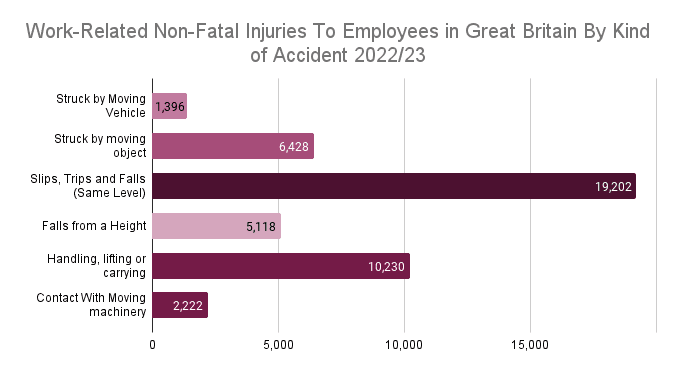
As you can see, slips, trips and falls on the same level accounted for the highest recorded non-fatal injuries. Also, these statistics cover all workplace areas including warehouses.
All accidents at work must be reported, even minor ones. It is the law that all workplaces of more than 10 employees must keep an accident book on site. The injury should also be reported to a line manager or shift supervisor immediately. This is to both get help and prevent others from being harmed.
In addition to this process, certain serious injuries must be reported by employers through something called the Reporting of Injuries, Diseases and Dangerous Occurrences Regulations 2013 (RIDDOR). In both instances, requesting a copy of the accident report may be possible and this can be used as evidence in your personal injury claim for compensation.
Two heads of loss are taken into account when calculating personal injury compensation. General damages apply a figure for the physical pain and any psychological injuries caused by the warehouse accident. They also take into account any long-term health issues, treatments and what the anticipated length of recovery will be.
Therefore, medical proof is a vital way of helping to determine what you could be owed. To assist with this, an independent medical assessment can be carried out and a solicitor can arrange this for you.
Alongside the medical report, those responsible for calculating general damages might consult with publications such as the Judicial College Guidelines (JCG). This document lists award bracket amounts for an array of injuries and below, we’ve compiled an excerpt with injuries that might relate to a warehouse accident:
Please note that these amounts are for guidance purposes only. Compensation amounts will always differ from case to case. Furthermore, our table has a topline entry that does not come from the JCG:
| INJURY | SEVERITY | AWARD GUIDELINES | NOTES |
|---|---|---|---|
| Multiple Types of Injury and Special Damages | Severe | Up to £1 million plus. | This award level refers to cases of multiple severe injury and special damages for missed earnings, care costs and medical bills. |
| Head | (a) Very Severe | £344,150 to £493,000 | Some ability to react to commands but there is a permanent reliance on others for all basic needs. |
| Chest | (b) Traumatic Injury | £80,240 to £122,850 | Traumatic damage to chest, lung(s) or heart with impaired physical disability and reduced life expectancy. |
| Hands | (b) Serious Damage to Both Hands | £68,070 to £103,200 | Injuries that give rise to a permanent cosmetic disability and significant function loss. |
| Leg | (ii) Very Serious | £66,920 to £109,290 | Injuries that cause permanent mobility issues or instances of fractures that require years to fully heal. |
| Neck | (a) Severe (iii) | £55,500 to £68,330 | Fractures and dislocations as well as soft tissue injuries and tendon damage that causes significant and permanent disability. |
| Back | (a) Severe (iii) | £47,320 to £85,100 | Fractures and lesions to vertebral bodies and soft tissue injuries causing continuing pain, discomfort and disability. |
| Ankle | (b) Severe | £38,210 to £61,090 | Injuries that require a prolonged period with the ankle in plaster or may require the insertion of surgical pins. |
| Wrist | (b) Significant | £29,900 to £47,810 | Injuries that cause a significant level of disability but some level of useful movement remains. |
| Arm | (c) Less Severe | £23,430 to £47,810 | Despite significant levels of disability, a substantial recovery takes place or is expected to. |
You could also be eligible to claim for the second head of loss called special damages. These reimburse you for any monetary losses caused by your injuries. Documented evidence must prove these amounts and some examples of what you could include are:
Our team of advisors can discuss general and special damages with you right now. Simply reach out through the contact options above and they can answer any questions, as well as assess the strength of your potential claim.
It makes sense to see if you are eligible for help from a solicitor to start your case. Their expertise and insights can help you gather supporting evidence. Also, they will collect statements, meet deadlines and guide you confidently through the claims process.
You may have hesitations about appointing a lawyer because of legal costs. If so, we can offer a possible solution. Our personal injury solicitors can work with eligible claimants through a type of No Win No Fee agreement. They typically suggest a Conditional Fee Agreement (CFA) which offers the following advantages to the claimant:
Take a moment to connect with advisors for your free case assessment. If you wish to use our services and your claim is eligible, they could connect you with excellent legal representation today:
In addition to warehouse accident claims, these other guides may help:
Some external links to help:
Lastly, thank you for taking the time to read our guide on warehouse accident claims. For any further help on this topic, please reach out to advisors using the contact options above.