Thank you for visiting Accident Claims. This is our Virtual Legal Assistant. To save you time, you can
ask any questions you like about your case and we'll provide you with the essential information from our
site. If you'd like to speak with us directly, call us on 0800 073 8801. We're open 24
hours a day.
Common Questions:
X
Free initial advice
How To Make Water Sport Personal Injury Claims
If you've been hurt, our trusted solicitors can help
No upfront fees. No obligation. A specialist will review your enquiry and come back to you.
Trusted by injured people across the UK
100% No Win No FeeNothing to pay upfront
Over £100m WonSecured for injured clients
1000s of ReviewsProof from real clients
In this guide on water sport personal injury claims, you will learn about the different types of activities that may lead to an accident at a water sport activity centre. Furthermore, this guide will explain the duty of care that you’re owed, as well as the steps that you can take to make a claim.
To understand the water sport personal injury claims process, it would be useful to know some basics first. When you make a claim you must be able to prove that the water sports accident happened because of negligence.
In order to determine whether negligence led to your injuries, you’d need to answer “yes” to the following three questions:
Were you owed a duty of care by the party in control of the water sports centre?
Was this duty of care breached?
Were you injured as a result of this?
There are other considerations to bear in mind, for example, whether you’re starting your claim within the appropriate limitation period. For more information on the process of making water sport personal injury claims, why not get in touch with our team today?
How Common Are Fatal Accidents Involving Water?
The National Water Safety Forum provides annual reports of fatal accidents involving water using data extracted from the Water Incident Database. We’ve featured some key statistics from their 2020 report below:
There were 242 suspected fatal incidents where it was suspected to be an accident
Fatal accidents and natural causes incidents involving men were most common in 20 to 24-year-olds
On the other hand, in women, these accidents were most common for 15 to 19-year-olds and 40 to 44-year-olds
Our team of advisors can help you understand the strength and validity of your claim. Get in touch for a free valuation.
Types Of Water Sports
Water sports can involve an array of activities. It’s worth repeating that you need to prove that the negligence of an activity provider caused an accident in which you sustained an injury in order for you to be able to claim.
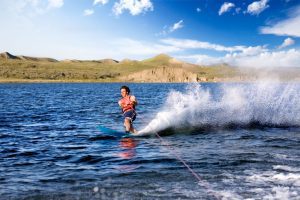
Here are some types of water sports that you could participate in a water activity centre:
Jet skiing
Canoeing
Scuba diving
Rowing
Boating
Windsurfing
Parasailing
Snorkelling
Kitesurfing
If you can’t see the activity that caused your injury mentioned above, speak to our advisors for some insight on water sport personal injury claims. They may connect you to one of our solicitors if you have a valid claim. They can then give you an estimation of how much compensation you could recieve.
What Could Cause A Water Sport Accident?
In this section, we will look at some potential causes of water sports accidents that could happen as a result of activity providers acting negligently and breaching their duty of care.
Faulty protective equipment- Activity providers should carry out regular maintenance checks on protective and safety equipment, such as life jackets, to ensure they are not faulty and are working properly. There is a risk of drowning if your life jacket does not work.
A lack of signage- Hazards that cannot be removed or reduced should be signposted. For example, if a particular part of the water is shallow or filled with rocks, there should be signs in place advising not to jump in at this point. If someone dives into unsafe water, this could cause a head injury.
Inadequate training- If staff do not properly train you on how to use equipment, for example how to secure your feet into your water skis, you could sustain an accident such as an ankle injury.
For more information on the kinds of accidents that could form the basis of a valid claim, speak with an advisor today.
What Should You Do After A Water Sports Accident?
Another important element to the water sport personal injury claims process is having sufficient evidence. Some forms of evidence you might consider obtaining include:
Contact details of witnesses
Photographs of your injury, or your equipment, if it was defective and caused your accident
If possible, obtain CCTV footage showing your accident at the water sport activity centre
Complete an accident book report
You could also be invited to attend a medical assessment as part of your claim. The report that this generates will be used to value your settlement. However, for your own health and safety, you should seek medical attention after you’ve been injured.
Water Sports Personal Injury Claims Time Limits
The Limitation Act 1980 states that the time limit to make a claim is typically within 3 years of the date of the accident or the date you realised that your injuries were caused by negligence. This doesn’t mean that your claim will need to be concluded in 3 years, but rather you should have issued court proceedings within this time.
Some exceptions can apply, however. To find out more, speak to our team today.
Water Sport Personal Injury Claims Calculator
Now that we’ve looked at the water sport personal injury claims and the evidence that you might need to collect, you might be wondering how much compensation you could recieve. There are two types of damages that personal Injury claims can include:
General damages: You may claim general damages for the pain, suffering and loss of amenity that your injuries have led you to experience.
Special damages: You are able to claim special damages if you can provide proof that your injuries have caused you financial losses. This could include loss of earnings, medical costs and care costs.
Using the Judicial College Guidelines, a document used by solicitors to value injuries, we’ve put together a table featuring guideline compensation brackets.
Injury
Compensation Range
Notes
Moderate (i) Brain Damage
£140,870 to £205,580
Symptoms may include a moderate to severe effect on sight, speech and senses.
Minor Brain or Head Injury
£2,070 to £11,980
The level of award within this bracket is determined by the extent of ongoing symptoms, such as headaches.
Partial Hearing Loss or/and (i) Tinnitus
£27,890 to £42,730
Severe tinnitus as well as noise-induced hearing loss
Severe (i) Neck Injuries
In the region of £139,210
You may suffer severe headaches which prove to be intractable and have little or no movement in the neck.
Moderate (i) Neck Injuries
£23,460 to £36,120
This bracket might include fractures or dislocations.
Minor (i) Neck Injuries
£4,080 to £7,410
A recovery is expected to take place over the space of a year or two.
Very Severe Ankle Injuries
£46,980 to £65,420
Extensive soft-tissue damage or a transmalleolar ankle fracture.
Severe Ankle Injuries
£29,380 to £46,980
There will be significant residual disability in the form of a severely limited ability to walk.
Moderate Ankle Injuries
£12,900 to £24,950
This bracket might include broken bones and tears to the ligament which could result in difficulty standing or walking on uneven ground.
Modest Ankle Injuries
Up to £12,900
Can include minor fractures that are not displaced, minor injury to ligaments and sprains.
It’s worth noting that the compensation brackets listed above are not a definite estimation of what you may receive if your claim is successful. Speak to our advisors, who can value your claim for free. Furthermore, they could connect you with one of our lawyers if you have a valid claim.
Contact Us To Make No Win No Fee Water Sport Personal Injury Claims
Our solicitors offer clients a No Win No Fee agreement to make the process of funding legal representation as stress-free as possible. This kind of agreement means that you won’t pay anything to your lawyer upfront or as they work on your claim.
If you receive compensation, then your solicitor will deduct a percentage of your compensation. This is a “success fee”, and the percentage that it consists of is legally limited.
Our advisors can connect you with one of our solicitors if your claim is valid. You can:
Contact us about any queries using our online form
As we come to an end on this guide on how to make water sport personal injury claims, we thought you might find the following resources useful:
Water sports safety– This information from the Royal Society for the Prevention of Accidents (RoSPA) outlines some of the safety approaches to take in watersport scenarios.
First aid – NHS advice on what to do if someone is injured.
Here are some of our additional guides that may come in handy.
Fatal Accident Claims– Informaiton on claiming if someone has lost their life due to negligence.
We hope that you have found this guide useful. Please don’t hesitate to get in touch if you have more queries about the water sport personal injury claims process.
Guide by LJ
Edited by FS
Quick Links
Contact information
Email: info@accidentclaims.co.uk Telephone: 0800 0738801 Address: Suite 3 And 3.1, Exchange Court, 1 Dale Street, Liverpool Merseyside, L2 2PP